
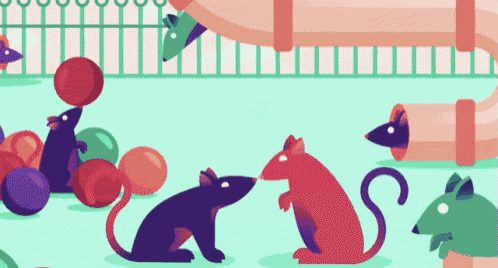
There is a fascinating experiment from psychology that offers an interesting way of thinking about workplace culture.
In the late 1970s, psychologist Bruce Alexander and colleagues conducted what became known as the Rat Park experiments. The popular story is simple: rats living in isolation with access to morphine consumed much more of it than rats living in an enriched environment with other rats, space, stimulation and opportunities for social interaction.
The science and interpretation of Rat Park are more complicated than the popular version suggests. The findings have been debated and some aspects have proved difficult to replicate. For me there is an idea within the experiment that is incredibly useful when thinking about workplace culture:
Behaviour doesn’t happen in a vacuum. The environment around us influences what becomes normal, attractive, tolerated and possible.
And that matters enormously at work.
What is our workplace “Rat Park”?
Imagine two workplaces.
In the first, people feel connected to their colleagues. They have friendships. They know who they can talk to when things aren’t going well. Leaders listen. People can admit mistakes. Challenging poor behaviour isn’t regarded as disloyalty. It’s simply the right thing to do.
There is a sense that: Around here, we look out for each other.
Now imagine another workplace.
People feel isolated. Hierarchy is powerful. Showing vulnerability is seen as weakness. Poor behaviour is laughed off. People know something isn’t right but don’t want to be the person who says it. Challenging a colleague is interpreted as betrayal. Everyone has learned to keep their head down.
Both workplaces contain individuals who are capable of making good choices but they don’t provide the same social environment in which those choices are made.
That is where the Rat Park analogy becomes interesting.
The “morphine” of a toxic culture
I’m not suggesting that poor workplace culture causes addiction. That would be an entirely inappropriate conclusion to draw from Rat Park. Instead, think of morphine as a metaphor for something else: the immediate rewards that unhealthy cultures can provide.
Bad behaviour can provide belonging, “That’s just how we do things here.”
It can provide protection, “We look after our own.”
It can provide status, “Don’t be the person who rocks the boat.”
It can provide relief, “Everyone has a laugh about this stuff.”
Eventually people can find themselves participating in behaviour that they might never have engaged in on their own.
Why? Because the behaviour has become part of the social environment. By the way don’t take my word for it. Decades of social science research confirm this.
The individual still has agency. They are still responsible for their actions. But if everyone around them is behaving in a particular way, the psychological and social cost of doing something different can become much greater.
This is one reason culture matters so much.
The same applies to wellbeing
There is another side to this. A person can enter an organisation with strong relationships, confidence and healthy ways of coping.
But imagine repeatedly receiving the message:
Don’t complain. Don’t show weakness. Don’t challenge the group. Get on with it. Keep your head down.
Over time, the environment can begin to erode the very things that help people cope. Someone struggling may not ask for help. Someone experiencing bullying may convince themselves that it’s simply part of the job. Someone who is isolated may become even more isolated. Someone who sees poor behaviour may decide that intervention isn’t worth the personal cost.
Again, we shouldn’t reduce this to “the culture caused their problem.”
People are complex.
Wellbeing is complex.
But the environment matters.
Sometimes we make the mistake of looking exclusively at the individual when we should also be asking:
What is happening around them?
This is where active bystandership comes in
We often talk about active bystandership as though it is primarily about intervening when something bad happens.
I think it is much bigger than that. A colleague notices someone becoming withdrawn. They ask how they are.
Someone hears a joke that crosses a line. They challenge it.
A new member of staff is being excluded. Someone brings them into the group.
A colleague is struggling. Someone notices early and starts a conversation.
Someone behaves badly. A colleague has the confidence and permission to say: “That’s not how we do things around here.”
None of these interventions is necessarily dramatic. But collectively they change the environment.
They create social signals about what is normal.
They demonstrate what colleagues expect from one another.
They make support visible.
They make intervention less unusual.
And they create something particularly important: alternatives.
If the dominant message in a workplace is “keep quiet and fit in,” then silence becomes the easiest option.
But if the dominant message becomes “we look out for each other,” then speaking up, checking in and challenging poor behaviour become easier choices.
The park has changed.
We shouldn’t just train people to behave better
This is perhaps the biggest lesson I take from Rat Park.
Organisations sometimes respond to cultural problems by focusing almost entirely on the individual.
More training.
More policies.
More awareness.
More instructions about what people shouldn’t do.
All of these can have a place. But we also need to ask:
What kind of environment are we creating for people to work in?
Because culture isn’t simply what leaders say. It is what people experience. It is built through thousands of interactions between colleagues every day. A supportive culture doesn’t remove individual responsibility.
It supports people in exercising it.
It makes it easier to ask for help.
Easier to challenge.
Easier to intervene.
Easier to admit that something isn’t right.
Easier to do the decent thing.
And perhaps that’s the most useful way to think about Rat Park in the workplace: Don’t just ask people to make better choices. Build an environment that makes better choices easier.
Because a good culture doesn’t just protect people from harm.
It protects the good in people.

