
A sense of responsibility has been found to be a big motivator that supports individuals to move from a passive role to an active one. This blog aims to discuss the role of responsibility and how teams and organisations can harness it’s power.
Imagine you’re standing at the edge of a river, and someone falls in. You didn’t push them, but you are there when it happens. You can see what’s happening. Responsibility in that moment isn’t about guilt or feeling for the person as they fall, it’s about your ownership of your role in the scene.
As a detective in Edinburgh in the 1990’s I turned up at crime scenes and took control. Why? It was my job. It was my responsibilty to take charge. As a police officer when new don’t take charge of a situation bad things can happen. It’s the same in any similar type of profession. Trained first aiders also take responsibility. They don’t wait they assume control. They also give responsibility to others.
For an active bystander, taking responsibility means breaking the spell of a diffusion of responsibility, the psychological effect where everyone thinks “someone else will step in.” If nobody takes ownership, the harmful behaviour or event just keeps going unchecked. By stepping up, even in a small way, you’re acknowledging: “This is happening in my presence, so I have a part to play in shaping the outcome.”
Taking responsibility is important because:
- Responsibility unlocks agency. Without it, people fall into passivity. With it, you recognise your power to influence events.
- It protects the vulnerable. Harm usually thrives on silence. Responsibility means choosing not to be complicit. You stop harm.
- It creates ripple effects. One person acting responsibly often emboldens others to step forward too. What you promote you permit.
Think of it like a chain reaction: responsibility leads to action which leads to change. Without responsibility, the first link never catches, and the harmful behaviour just loops on and on. In some cases, it evolves into something more serious
So why do many of us humans dodge responsibility?
Well, us humans behave strangely when groups are involved. A few key issues arise –
- Diffusion of responsibility: The classic. In a crowd, people assume “someone else will do something.” Paradoxically, the more people around, the less likely anyone acts. This is often clear when situations are ambiguous.
- Social loafing occurs when in groups we risk putting less of an effort in. It’s like a diffusion of responsibility and stronger in larger and more anonymous groups.
- Social proof: We often look to others for cues on how to behave. If nobody else is reacting, it feels risky to be the first.
- Fear of consequences: What if I misread the situation? What if I make things worse? That fear of embarrassment or retaliation keeps us frozen.
- Moral disengagement: Sometimes people mentally minimize the harm thinking “It’s not that big a deal” so to avoid the weight of responsibility.
The way out is always: “It’s not on me.” Responsibility is about deliberately shutting that hatch and saying, “Actually, it is.”
Once you accept responsibility, you don’t have to be a hero in a cape, you just need to pick a move. A range of tools exist that lead on from the moment you take responsibility. Remember you don’t have to step in at the time. You could also delegate responsibility to someone else. That could be police officer, door steward or simply someone who is closer than you are to the people involved. When you know what to do taking responsibility becomes easier. It means not shrugging it off. Even a delayed or indirect move is still an act of responsibility.
So responsibility is the bridge between noticing harm and choosing action. Without it, we’re spectators. With it, we’re participants in shaping what happens next.
Now, if we zoom out further, responsibility isn’t just about one-off incidents. Many who do this work tend to support people to intervene at the point of attack. First, that’s kind of too late for me. It’s like a good game of whack a mole. Secondly it can be dangerous and as we know the slightest whiff of risk many humans, rightly walk away. Whilst important this work is also about building a culture where everyone assumes that role as default. That’s when active bystander shifts into community norm. One person taking responsibility is powerful, but a culture where everyone expects to act? That’s how you get real social armour. This is where you prevent issues for the long term. In workplaces you reduce likes of bullying and harassment. You also support the wellbeing of your staff. Many people want to do more but when the culture is unsafe to act many people don’t act. The result can be a moral injury which leads to guilt and bad wellbeing.
So how do we build a culture of responsibility? Here’s what I’ve learned.
- Normalize speaking up. If people regularly see peers challenging harmful jokes or behaviours, or checking in on each other, it becomes ordinary, not exceptional. Responsibility feels less like stepping into the spotlight and more like just doing your part. When leaders create culture where responsibility is instilled in staff people will act early.
- Create shared language. Short, simple phrases like “Not cool,” “Check in,” “Let’s move” or “take a break” give people tools to intervene without overthinking. A culture thrives when there’s a common ‘manual’ everyone can draw from.
- Practice through stories and scenarios. When communities talk openly about “what would you do if…” and rehearse options, responsibility stops being something written in a code of conduct. You get muscle memory. It’s the difference between fumbling for a defibrillator in an emergency and knowing exactly where it is.
- Celebrate interventions. Shining a light on people who do take action reinforces that responsibility isn’t just expected, it’s valued. Recognition transforms the idea from burden into badge of honour. Encourage staff to welcome interventions and to thank their colleagues, even when they get it wrong.
- Spread the net of responsibility. When leaders, teachers, coaches, or peers model stepping in, others follow. Responsibility cascades downward: if those with influence act, it signals to everyone else that they can too.
A community with a shared ethic of responsibility breaks the isolation that harmful behaviour feeds on. Harassment, bullying, exclusion—they all rely on silence. When silence isn’t the norm, the whole environment shifts. Those who commit harm will change, some leave. Victims feel supported. It’s a form a herd immunity but for harm. When enough people take responsibility, harmful behaviours struggle to spread or survive.
Remember rules are only as strong as the culture enforcing them. You can plaster “zero tolerance” posters on every wall, but without a responsibility-minded community, they’re just wallpaper. With that culture, though, the rules practically enforce themselves.
Now, here’s a twist to chew on. What’s best? Responsibility in a community works better when it’s framed as protection “we keep each other safe” or as identity “this is who we are” ?
Both are powerful, and they shape the culture in different ways. Framing it as protection and as identity each pulls on very different psychological levers.
Responsibility as protection: This taps into our instinct to guard, defend, and care for others. It frames responsibility as shielding others (or ourselves) from harm, ensuring safety and stability. Think of a police officer protecting lives, or a parent protecting a child’s well-being. The advantage here is urgency—it sparks vigilance and action when threats are present. The downside: it can breed fear-based motivation. People may step up when danger looms but disengage once the “storm has passed.”
Responsibility as identity: This connects responsibility to who I am. It’s about living up to values, roles, and a sense of self. “I act responsibly because I am the kind of person who does.” For me this framing of responsibility endures even when no one is watching, and no crisis is at hand. The advantage here is consistency and resilience.
So, which is “best”? For long-term motivation, identity framing tends to be more powerful because it weaves responsibility into self-concept, not just situation. Research confirms that people who are closely connected to their values (identity) are very likely to act even when challenges are present. But protection framing is strong in moments of crisis, where people rally around a shared danger or vulnerable group. In likes of policing framing responsibility as looking out for colleagues and the community is a good way to motivate action.
The most effective leaders and communities often weave the two: “We protect because of who we are.” That ‘golden thread’ keeps responsibility alive both in both the tough and easy times.
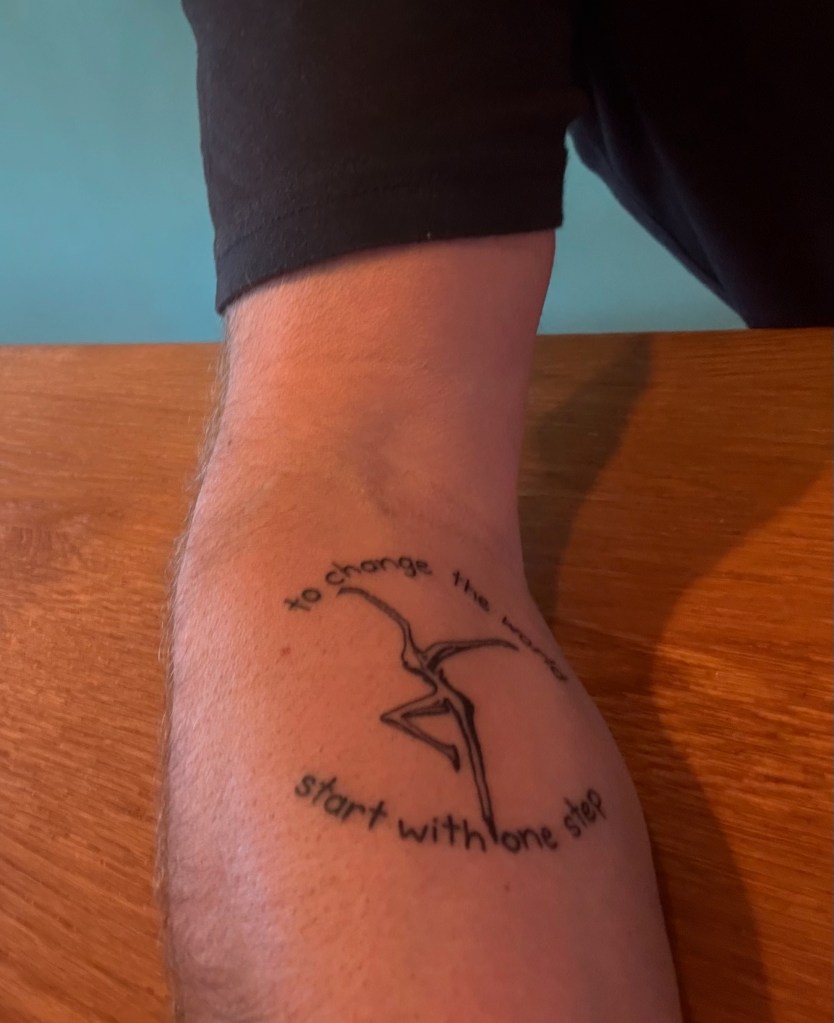
To end, this blog has introduced you to what I think is the first step to help make change. To change the world, start with one step – the opening line from the song by the Dave Matthews Band, “You might die trying,” and the words I chose to use when I got my first tattoo last month. When we take responsibility, we are taking that first step and however small, the first step is the hardest of all.
 grahamgoulden.com