Most people imagine harm begins with one terrible act. It rarely does. As I say often harm evolves a joke goes unchallenged, a colleague is excluded, a rumour spreads someone looks uncomfortable, but nobody says anything. Each small act makes the next one easier.
This is one of the central insights from the work of Ervin Staub. Decades of research into genocide, political violence and everyday cruelty led Staub to conclude that mass harm is usually the result of an incremental process. Small acts of disrespect, discrimination and dehumanisation become normalised until behaviours that once seemed. unthinkable become accepted. The question then becomes: what stops that process? The answer is moral courage.
Moral courage is choosing to do what is right despite the personal cost. That cost may not be physical danger. More often, it is social. Fear of embarrassment. Fear of standing out. Fear of upsetting colleagues. Fear of challenging someone with more power. Those fears are real. Research by Solomon Asch showed how easily people conform to a group, even when they know the group is wrong. Stanley Milgram demonstrated the extraordinary influence of authority, while Philip Zimbardo illustrated how situations and social roles can shape behaviour more powerfully than we like to admit.
Together, their work reveals a simple truth: doing nothing often feels safer than doing the right thing. That is precisely why moral courage matters. It interrupts the evolution of harm. A respectful challenge, a question asked, support offered to a colleague or reporting behaviour before it escalates. These are often small actions, but they change the direction of travel. They replace silence with accountability and make it harder for harmful behaviour to become the norm. This is how cultures change. Malcolm Gladwell’s ‘Tipping Point’ is achieved.
The encouraging news is that courage is contagious. Research on active bystandership shows that when one person intervenes, others are far more likely to follow. One act of courage can reset the expectations of an entire group. Organisations therefore face a choice. They can wait for exceptional individuals to be brave, or they can build cultures were speaking up is normal, supported and expected.
The evolution of harm is not inevitable. The presence of harm depends on countless moments when people choose comfort over conscience. It is stopped in the same way. One moment of moral courage at a time.
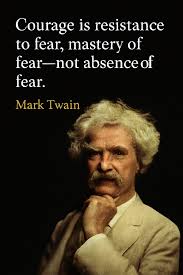
Courage isn’t the absence of fear; more it’s the mastery over (Mark Twain). Perceptions and assumptions become default in unsupportive cultures. In safe cultures support helps to reduce the fear. When we reduce fear, moral courage becomes more likely.