
Bad news sells; that’s clear. However, do the headlines always communicate the truth?
When organisations announce that whistleblowing reports have increased, the reaction is often predictable. Headlines suggest something has gone wrong. Leaders become defensive. Employees wonder whether the workplace has become more toxic.

A recent report from the Scottish media suggested that the City of Edinburgh Council (CEC) had experienced an increase in whistleblowers coming forward to report inappropriate behaviour. For many observers, that sounds like evidence of a worsening culture. But what if the opposite is true? If an organisation has invested in active bystandership training and encouraged people to speak up, an increase in whistleblowing may be one of the clearest signs that the culture is becoming healthier.
The critical question isn’t: “Why are more people reporting?” It’s: “Why were so few people reporting before?”
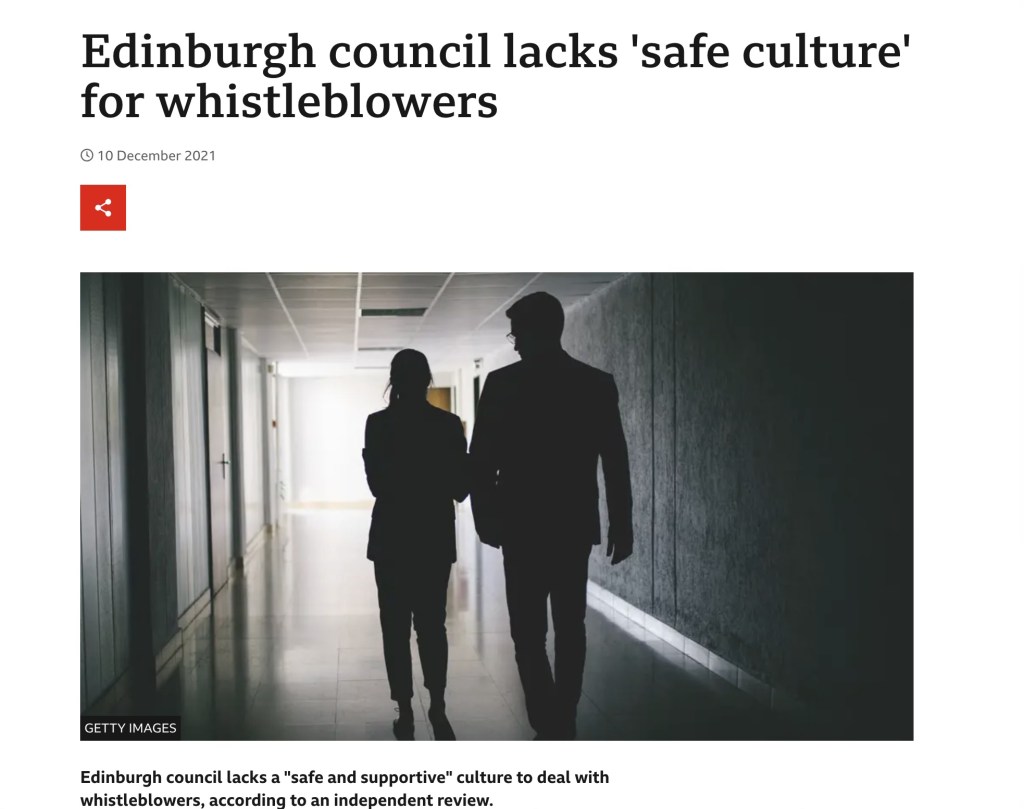
This headline from 2021, I think, provides some important context to the recent story, which fails to acknowledge that the CEC may have actually been putting some effort in.
They have, and I know this because? I have supported them since 2021 in building the type of culture that feels better able to address harm early, but also in reporting harm officially when required. To be clear, I’m not claiming I’m the reason for this ‘good news ‘, but I do know I’m part of the response, which is supporting the culture
The Myth of Silence
Many organisations mistakenly assume that low numbers of complaints or whistleblowing reports mean everything is fine. Research consistently suggests otherwise. People frequently stay silent, not because nothing is happening, but because they believe speaking up will come at a cost.
Employees worry they will be labelled difficult, damage their career, lose friendships, or simply be ignored. Others assume someone else will intervene—a phenomenon well known in psychology as the bystander effect.
Over time, silence becomes normal. Small acts of disrespect go unchallenged.
Bullying becomes “just banter.” Sexist comments become “part of the culture.” Unsafe practices become “how we’ve always done it.” The absence of reports doesn’t necessarily reflect the absence of harm. Often, it reflects the presence of fear.
Active Bystandership Changes the Equation
This is exactly what active bystandership training seeks to change.
Too often, organisations focus solely on teaching people how to intervene. Those practical tools matter, but perhaps even more important is creating permission to act.
People need to know that speaking up is expected rather than exceptional. They need confidence that leaders will support them, colleagues won’t ostracise them, and concerns will be taken seriously. Once that permission exists, something interesting happens. Reporting often increases. Not because misconduct has suddenly become more common. Because silence has become less common. The hidden becomes visible.
I’ve seen this play out in many of the different settings I’ve supported. In schools, I’ve seen an increase in child protection referrals after similar training. As well as increases in anonymous reports, I’ve seen increases in official complaints made directly to HR departments. Such a focus helps to reduce fear and so increase the opportunities to prevent harm.
Psychological Safety in Action
This links closely with the concept of psychological safety, developed by Amy Edmondson. Psychological safety is not about making people comfortable. It is about creating an environment where people believe they can raise concerns, admit mistakes and challenge inappropriate behaviour without fear of humiliation or retaliation.
In organisations with high psychological safety:
- People admit errors earlier.
- Problems are identified sooner.
- Poor behaviour is challenged more consistently.
- Learning improves.
Importantly, these organisations often report more concerns in the short term. That isn’t failure. It’s visibility and visibility is the first step towards improvement. Who would have thought that the most harmonious teams aren’t the quietest, but the loudest.
Ervin Staub’s Warning
The work of Ervin Staub provides another powerful explanation. Throughout decades of research into genocide, violence and altruism, Staub argued that serious harm rarely appears overnight, it evolves. Minor acts of disrespect become tolerated. Small abuses of power become accepted. Gradually, behaviours escalate because nobody interrupts them. His work demonstrates that passivity allows harm to evolve. Action interrupts that evolution.
Every organisation sits somewhere along that spectrum. The question isn’t whether harmful behaviour exists. The question is whether people feel able to stop it before it grows.
Measuring the Wrong Thing
Many organisations proudly report low numbers of grievances or whistleblowing cases.
That can be reassuring but it can also be dangerously misleading. Imagine two organisations. The first records five whistleblowing reports in a year. The second records fifty. Without context, many would conclude that the first organisation has the healthier culture. Yet the opposite may be true. The organisation with five reports may have a workforce terrified of speaking up. The organisation with fifty may have employees who trust the reporting system and believe leaders will act.
Looking only at the number of reports is like judging a hospital solely by how many illnesses it diagnoses. Finding more cases isn’t always bad. Sometimes it simply means you’re better at detecting problems that were always there.
From Whistleblowers to Active Bystanders
There is another important distinction. Active bystandership is not synonymous with whistleblowing. Whistleblowing is often the final stage when other interventions are impossible or have failed. An active bystander has many options long before reaching that point. They might:
- Challenge inappropriate language respectfully.
- Check in privately with someone affected.
- Ask a curious question that interrupts poor behaviour.
- Support a colleague who lacks confidence.
- Raise concerns informally with a manager.
- Seek advice before making a formal report.
Formal whistleblowing is simply one point along a continuum of intervention. Good active bystandership cultures aim to resolve issues early, before formal investigations become necessary.
The Leadership Challenge
For leaders, rising reports require courage. The easiest response is to worry about reputation. The better response is curiosity. Instead of asking: “Why are complaints increasing?” Leaders should ask: “Have we created an environment where people finally believe they will be heard?” That subtle shift changes everything.
An increase in reporting may represent years of hidden problems finally surfacing.
It may indicate greater trust in leadership. It may demonstrate that employees are taking responsibility for protecting colleagues rather than remaining passive.
In many ways, this is exactly what organisations should hope active bystandership training achieves.
What Success Really Looks Like
Perhaps we need to rethink how we define success. Success isn’t measured by having the fewest whistleblowers. Success is measured by having the fewest victims. In the early stages of cultural change, reporting may increase because more people feel able to intervene. Over time, as inappropriate behaviour is challenged earlier and more consistently, the behaviour itself should begin to decline.
That is the trajectory organisations should seek. Not silence. Not spotless statistics, but visible accountability followed by genuine improvement. Cultures don’t become safer when people stop reporting. They become safer when people stop looking the other way. An increase in whistleblowing after active bystandership training should therefore not automatically be viewed as evidence of organisational failure. It may instead be one of the clearest signs that the culture is beginning to heal.
When people who were once silent find the confidence to act, organisations gain something far more valuable than impressive reporting statistics. They gain a workforce that refuses to be passive in the face of harm, and that is where real cultural change begins.

