
Men’s violence against women and girls remains a massive issue and an issue that rightly needs a focus and concerted effort. However, are we talking about the issue correctly? Could ongoing approaches to the issue actually contribute to the problem itself? The headline captured in the image highlights a typical response. I feel we need a different response, a response supported by lots of research.
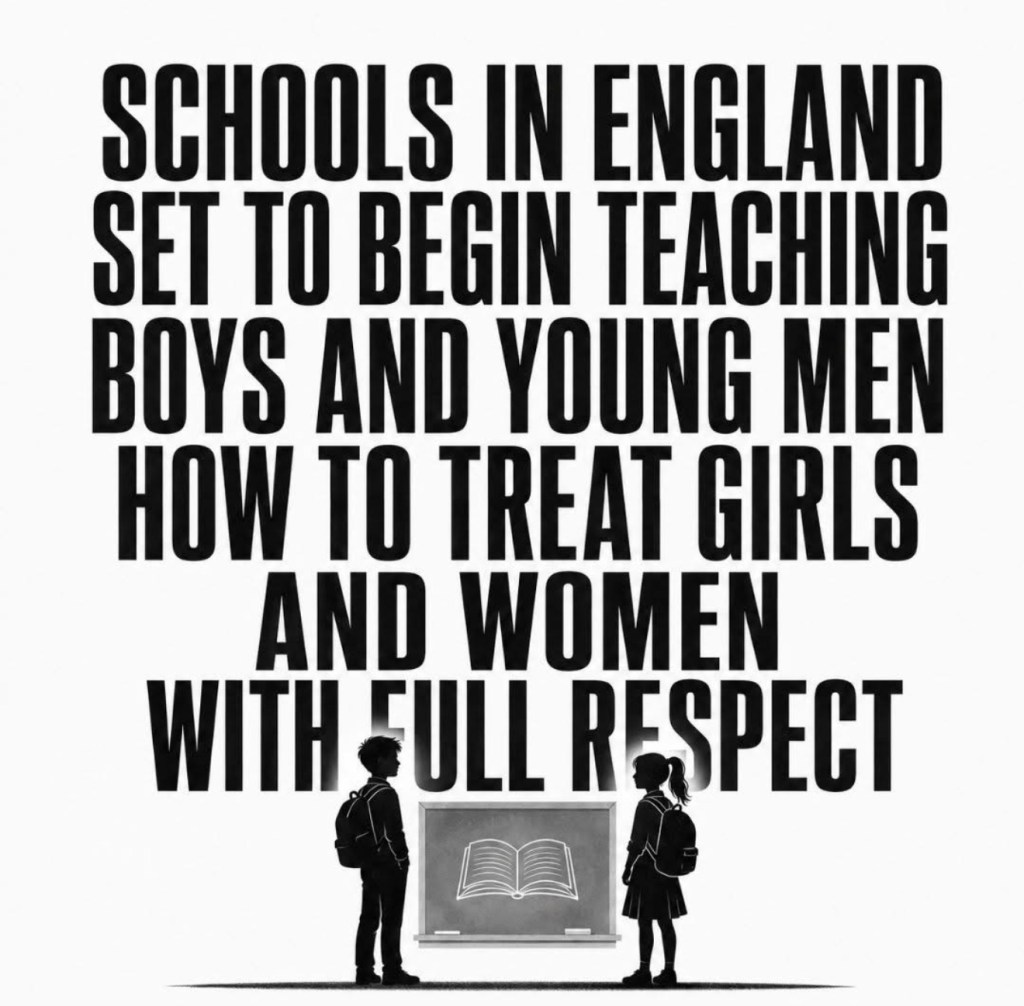
I read another headline recently. “1 in 4 boys support violence.” It is a powerful headline. It is uncomfortable. It makes us stop. It creates a sense that something needs to change, and perhaps it does. However, there is another question we should ask: What are the other three boys hearing? If the statistic is accurate, 3 in 4 boys do not support violence. Yet that isn’t usually the headline, and this matters. It matters because the message in the image above doesn’t recognise the 3 in 4. Its a lazy response and one i would argue keeps women and girls at risk.
The problem with the problem.
Robert Cialdini, one of the world’s leading thinkers on influence and persuasion, has written extensively about the power of social proof, our tendency to look at what other people are doing when deciding what is normal, acceptable or expected. He calls one particular communication error “the Big Mistake.”
The Big Mistake happens when we try to discourage harmful behaviour by highlighting how common it is. Cialdini famously illustrated this through the story of Arizona’s Petrified Forest National Park. Signs intended to discourage visitors from stealing pieces of petrified wood highlighted the scale of the theft problem. The unintended message was: “Lots of people are doing this” and that can become social permission. Cialdini’s argument is simple but profound: when communicating about harmful behaviour, we can accidentally make the behaviour appear more normal by repeatedly telling people how many others are doing it.
So, what happens when we repeatedly tell young people that violence, misogyny or harmful behaviour is widespread among boys? We may intend to say: “This is a serious problem. We need to stop it.” But some may hear: “This is what boys do,” and that is a very different message.
Imagine you are a young man sitting in a room with 4 of your peers. You’ve read the headline, and you’re wondering, “It’s not me, so who is it?” We all know that fitting in means a lot to any young person. We also know that attempts to challenge a friend can be difficult to. So much research exists that confirms young men often wrongly perceive what their friends think on topics such as misogyny. When we fail to correct the true norm, we further add to these misperceptions. Correcting these misperceptions is therefore key.
So, what should we say instead?
I’m not suggesting we minimise the problem. We absolutely need to talk about violence. We need to challenge misogyny. We need to understand why some young men adopt harmful attitudes, and we need to intervene when behaviour causes harm.
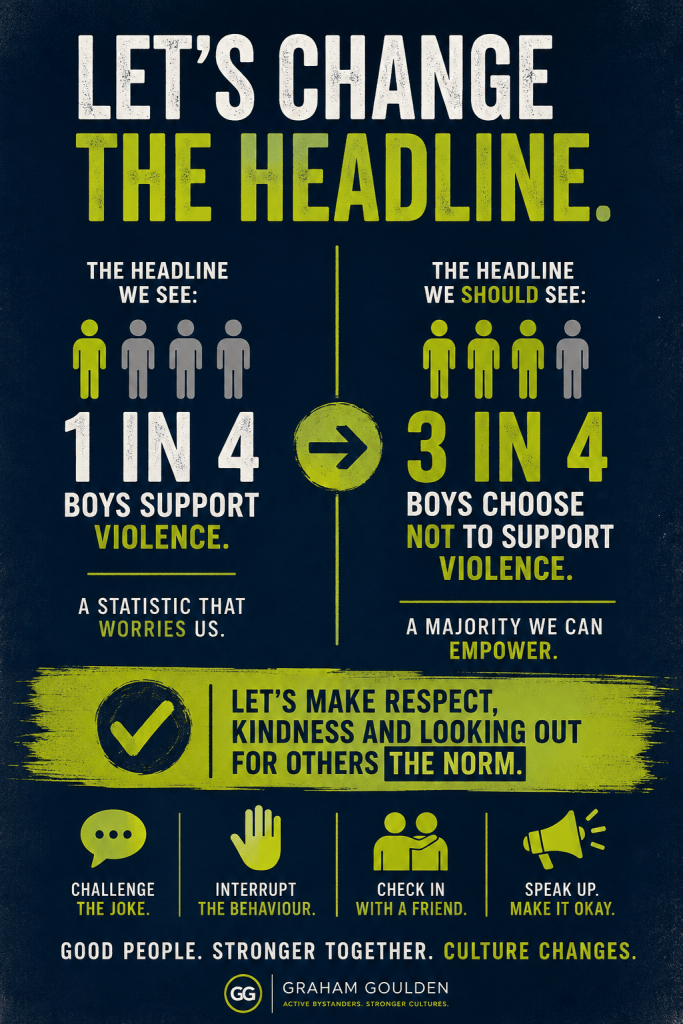
Alongside that, we should make the positive social norm visible. If three out of four boys don’t support violence, let’s talk about them. Actually, let’s shout about it.
Let’s ask what they believe. Let’s give them language. Let’s permit them to challenge their friends. Let’s make it normal to say:
“That’s not funny.”
“Leave her alone.”
“That’s not how we treat people.”
“Are you alright?”
“Mate, you’re better than that.”
These are the small moments where culture is created.
The majority matters
One of the most important lessons from active bystandership is that people don’t only need to know what not to do. They need to know what to do instead and, crucially, they need to know that other people will support them when they do it. Imagine the difference between these two messages: “1 in 4 boys support violence.”
Versus “3 in 4 boys don’t support violence. Let’s give them the confidence to speak up.”
The second doesn’t ignore the problem. It identifies an opportunity. It tells the majority:
You are not alone.
Your values matter.
You have a role to play.
That is powerful social proof, and Cialdini’s work suggests that when communicating social norms, we should be careful not to inadvertently make harmful behaviour appear more prevalent or acceptable. Instead, we can draw attention to the positive behaviour we want others to adopt.
From statistics to agency
Perhaps this is where our conversations about boys and violence need to evolve.
We often ask: “How do we stop the 1 in 4?” We should also ask: “How do we activate the 3 in 4?” because they aren’t simply a statistic. They are friends, brothers, teammates, classmates, colleagues, future fathers, future leaders and, importantly, potential active bystanders. We don’t need every young man to become a hero.
We need more young men to believe that everyday acts of courage are normal. To challenge the joke. To interrupt the behaviour. To check in with a friend. To refuse to join in. To stand beside someone who is being targeted.
Culture doesn’t only change when we confront the worst behaviour. It changes when we make the best behaviour visible, normal and expected. So perhaps we should change the headline. Not because the 1 in 4 doesn’t matter. But because the 3 in 4 might be part of the solution.
Don’t just tell young people what is wrong with their culture. Show them who is already helping to make it better and then permit them to lead the change.


By far, one of the best articles I have read and makes complete sense in every way.
The theory makes sense and to focus on the absolute majority of 75% of men who don’t commit violence against women and girls, empower them and single out the minority who have such a large impact.
I think you’re on to something here, GG!
LikeLike