
I started writing this blog just after the trial started. A big part of me wrote this in the hope that we would see justice for the victims and predator sent to jail. I confess I didn’t think I would publish this blog. In many cases justice is seldom seen.
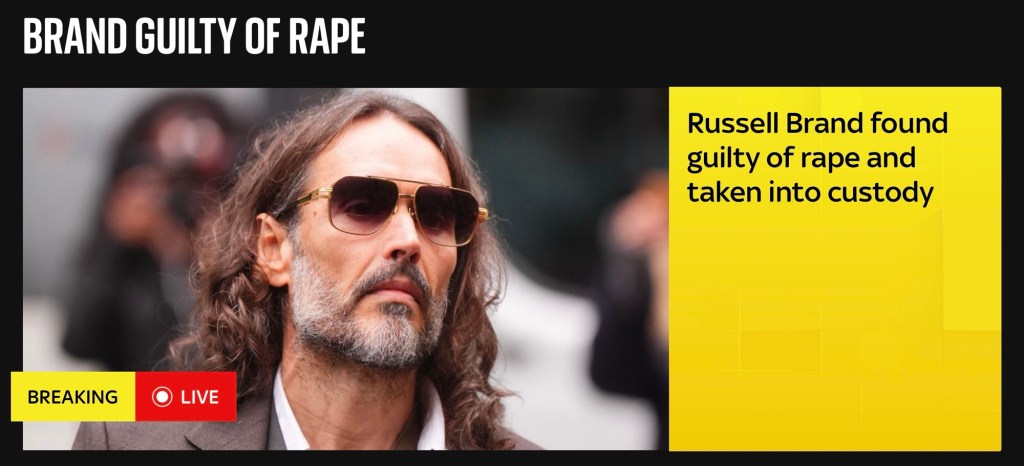
Russell Brand has been convicted of one count of rape and three counts of sexual assault involving four women. The verdicts, delivered at Southwark Crown Court on 5 November 2026, mark a significant moment in a case that has raised uncomfortable questions about celebrity, power, sexual behaviour and the culture that surrounds influential men.
But there is another question worth asking. How does someone become a predator in plain sight? And what role does the acceptance of certain behaviours play in allowing harm to continue?
Brand’s public persona was built, in part, around sexual promiscuity, outrageous humour and an unapologetic pursuit of women. His behaviour became part of his entertainment identity. Audiences laughed. Television programmes booked him. His celebrity grew.
We need to be careful here. Promiscuity is not rape. Sexual confidence is not sexual assault. A provocative comedian is not automatically a predator. Consensual sexual behaviour between adults is not the problem.
The problem arises when a culture becomes so accustomed to a particular image, or so entertained by particular behaviours, that it loses the ability to recognise when the boundaries of acceptable conduct have been crossed and that is where active bystandership becomes important.
When the joke becomes a warning sign
Social norms are powerful. They influence what we consider acceptable, what we challenge and what we quietly tolerate.
When a man repeatedly boasts about his sexual conquests, makes degrading comments about women or treats sexual entitlement as an amusing personality trait, those around him have choices.
They can laugh.
They can ignore it.
They can rationalise it as part of his character.
Or they can question it.
The danger is that repeated exposure can gradually change our perception. Behaviour that initially makes us uncomfortable can become familiar. Familiarity can become acceptance. Acceptance can become a form of permission.
This is not an argument that everyone who laughed at Brand’s jokes contributed to his crimes. Nor can we conclude that every friend or colleague knew about his offending. However, we should recognise that cultures which excuse sexual entitlement, reward dominance and treat women as objects create environments in which harmful behaviour can become harder to challenge.
The prosecution described Brand’s offending as involving manipulation and an abuse of power. The jury’s convictions were based on the evidence presented in court, not on his public image.
Yet his image invites us to reflect on the difference between seeing behaviour and understanding what it might signify.
Sometimes the warning signs are visible. What is missing is the willingness to interpret them differently.
The power of friendship: loyalty or critical loyalty?
What could friends and colleagues have done differently?
We cannot know what individual friends knew, witnessed or understood. We should not retrospectively assign responsibility for criminal acts to people who may have had no knowledge of them.
But we can explore what good friendship looks like when someone displays troubling behaviour.
First, friends can challenge the narrative.
Imagine a conversation in which a man boasts about his sexual encounters, dismisses a woman’s discomfort or jokes about ignoring boundaries. A friend might respond:
“Mate, that’s not funny. Are you listening to what you’re saying?”
It might feel awkward. It might disrupt the laughter. It might even threaten the friendship temporarily.
But friendship should not mean unconditional acceptance of everything someone does.
Second, friends can create opportunities for honest conversations.
“How are you treating the women in your life?”
“Are you confusing someone being attracted to you with them consenting to everything?”
“Would you be comfortable if your behaviour was described publicly?”
These questions are not accusations. They are opportunities for reflection, accountability and change.
Third, friends can refuse to become enablers.
That means not laughing at degrading jokes, not helping someone avoid accountability and not dismissing concerns raised by women as jealousy, misunderstanding or attention-seeking.
It also means listening when someone says they feel uncomfortable or unsafe.
The challenge is to move from blind loyalty to critical loyalty.
Blind loyalty protects the individual at the expense of others. Critical loyalty recognises that sometimes the most loyal thing you can do for a friend is to challenge them before their behaviour causes further harm.
Active bystandership: intervening before the criminal justice system
My work in active bystandership is built around a simple idea: ordinary people can make a difference when they recognise harmful behaviour and feel motivated, equipped and empowered to act.
We often focus on the dramatic intervention. Someone stepping between two people during a violent incident. Someone reporting serious misconduct. Someone confronting an individual who is abusing their power.
But active bystandership is also about the smaller moments.
The comment challenged.
The joke questioned.
The boundary reinforced.
The friend approached privately.
The colleague supported.
These moments matter because they can influence the social environment in which behaviour occurs.
A friend does not need to be a police officer, psychologist or relationship expert to say, “I’m concerned about how you’re behaving.”
Nor does intervention always require confrontation. Sometimes it involves checking in with someone who may have been harmed. Sometimes it means seeking advice or raising a concern through appropriate channels.
The objective is not to turn every friend into an investigator. It is to make it harder for harmful behaviour to flourish without challenge and importantly, active bystandership must never become a substitute for accountability. Friends cannot undo sexual offending through a conversation. They cannot guarantee that an intervention will prevent future harm. But they can help establish boundaries, challenge entitlement and support people who may otherwise feel isolated.
Changing the culture around men
There is a broader lesson here for men. We need to create environments where challenging a friend’s behaviour is understood as an act of courage rather than betrayal.
Too often, men fear losing friendships, being excluded from social groups or being labelled as humourless. The social cost of speaking up can feel greater than the cost of remaining silent.
But what if we changed that expectation?
What if men began to see challenging harmful behaviour as an essential part of being a good mate?
What if our social groups communicated a different norm?
“Around here, we look out for each other.”
That means looking out for potential victims. It also means looking out for friends who may be developing harmful attitudes or behaviours.
The message is not that every man is a potential predator. It is that every man has a responsibility to contribute to a culture where sexual respect, consent and accountability are non-negotiable.
From laughter to responsibility
The Russell Brand case should encourage us to reflect on the cultures we create around influential people.
We should ask ourselves:
What behaviours do we laugh at?
What behaviours do we excuse?
What concerns do we dismiss?
And what opportunities to intervene do we miss?
We cannot rewrite the past. We cannot know whether earlier interventions would have prevented Brand’s crimes.
But we can learn.
We can teach young men that respect is not weakness. We can encourage friends to challenge one another. We can build workplaces and social groups where speaking up is supported rather than punished.
Perhaps the most important lesson is this:
A culture does not become safer simply because we recognise harmful behaviour after the damage has been done. It becomes safer when ordinary people feel responsible for challenging that behaviour before the damage occurs.
The question is not simply whether we can recognise a predator in plain sight. It is whether we are prepared to challenge the behaviours, attitudes and social norms that allow someone to believe they can act without consequence.
Because being a good mate is not about protecting someone’s reputation. Sometimes, it is about having the courage to protect others from their behaviour and sometimes, it is about having the courage to help a friend become a better person before their actions destroy lives.

