
Every August, a new generation of medical students steps out of the lecture theatre and onto the ward. They know the science. They understand the evidence. They have spent years preparing for this moment. They have their new scrubs under their arm. But the ward teaches lessons no textbook ever can. This week I had the privilege of speaking to over 600 medical students from the University of Edinburgh Medical School (EMS) making that transition. This is my second year supporting an institution that is celebrating its 300th anniversary.
It is an exciting milestone, but it is also one of the most vulnerable moments in a healthcare professional’s career. They are entering environments where high-risk decisions are made quickly, hierarchies are deeply embedded, and human emotions are often at their rawest. These future doctors will be present at the start of life, the end of life and everything in between.
As I prepared for that session, my own world was centred on a hospice. My mum is nearing the end of her life. In recent days I have watched nurses, doctors, healthcare assistants, cleaners, volunteers and support staff carry out extraordinary acts of compassion with both my mum and my family. None of these actions will appear in a medical journal. None will make the headlines. Yet every one of them has shaped our family’s experience. These past days have reminded me that healthcare is built not only on clinical excellence but on thousands of tiny acts of humanity.
Those moments of care matter. As medical students begin their journey on the wards, they’ll spend years developing clinical competence. They’ll become better at diagnosis, interpreting scans and prescribing treatment. But another skill deserves equal attention. Learning to notice. Noticing the patient sitting quietly after everyone else has left. Noticing the junior nurse who looks overwhelmed. Noticing the healthcare assistant whose concerns haven’t been heard. Noticing the colleague who hasn’t smiled all day. Noticing when a consultant’s words unintentionally silence someone else in the room.
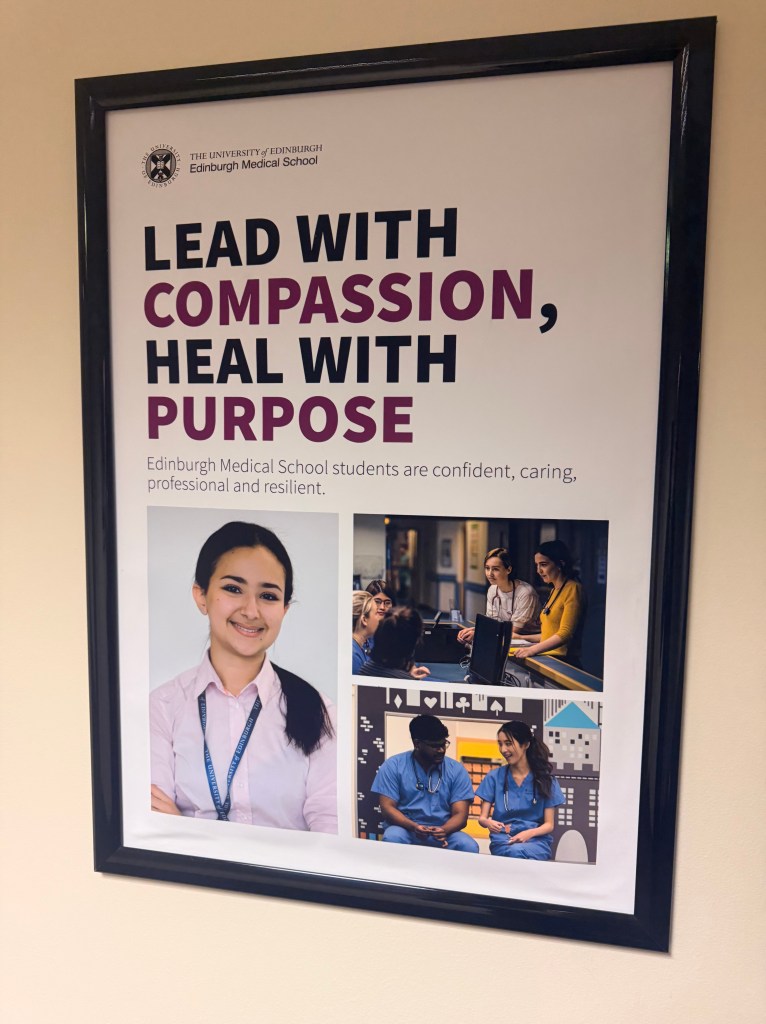
Leadership begins with noticing. Compassion begins with noticing. Active bystandership begins with noticing. Walking down the corridor to my training room this week, I noticed a poster on the wall. I recall seeing it last year. This year the words really captured me. The poster said, “Lead With Compassion, Heal With Purpose”.
The greatest challenge facing healthcare is rarely a lack of intelligence. The NHS is full of incredibly talented people. The challenge is that busy systems create invisible moments. When wards are stretched, targets loom and everyone is moving quickly, it becomes remarkably easy to overlook the person standing beside us. Psychologists call this inattentional blindness. We fail to see what is right in front of us because our attention is somewhere else. A famous example is the Invisible Gorilla Test.
In 1973, John Darley and Daniel Batson brought this to light on the Princeton University Campus. The study tested whether Seminary students would stop to help a person in distress. It found that the pressure of time pressure strongly affected helping behaviour. Even when students were told that the study would focus on the parable of the Good Samaritan, it made no difference. The pressure of the task was too overwhelming.
Healthcare professionals know this clinically. Yet it also applies socially. We can miss the colleague who needs support. We can overlook the student afraid to ask a question. We can ignore the joke that undermines inclusion. We can walk past behaviour that slowly erodes culture. None of this happens because people don’t care.
It happens because caring requires attention. That is why active bystandership is becoming increasingly important across healthcare.
Speaking up isn’t simply about challenging serious misconduct. It’s about creating environments where kindness becomes normal. Where questions are welcomed. Where concerns are voiced early. Where everyone, regardless of status, feels responsible for protecting both patients and colleagues.
In recent months and years every major healthcare inquiry reminds us that harm rarely appears overnight. It grows quietly. It begins with the small things people convince themselves aren’t worth mentioning. The dismissive comment. The ignored concern.
The assumption that somebody else will deal with it. The culture that says, “That’s just how things are.” By the time serious harm becomes visible, countless opportunities to intervene have already passed.
The opposite is also true. Healthy cultures are built through countless positive interventions. The Consultant introducing themselves properly to a student. The nurse inviting the quietest voice into the conversation. The healthcare assistant feeling confident enough to question a decision. A Junior Doctor admitting they don’t know something. Culture is never created by policies alone. It is created through repeated human interactions.
Medical students often worry about making mistakes. The reality is that everyone makes mistakes. This was made clear to me during my sessions with the medical students. All were desperate to learn but fearful of how mistakes would be addressed.
The safest professionals are not those who never get things wrong. They are those who create environments where mistakes can be identified, discussed and learned from before they become tragedies. That requires what Amy Edmondson calls Psychological Safety. In my opinion, such safety begins with compassion. Compassion is sometimes misunderstood as softness. It isn’t. Compassion is courage. It is choosing to notice, choosing to ask, choosing to speak, choosing to help. Sometimes compassion means sitting silently beside a grieving family. Sometimes it means questioning a senior colleague because patient safety demands it. Sometimes it means encouraging a fellow student who doubts themselves. All require courage, and courage is something that anyone entering the medical profession will likely demonstrate on a daily basis.
Back to my own family’s current experiences. As I watched the staff in the hospice this week, I realised something important. Families rarely remember the technical details of care. They remember how people made them feel. They remember the nurse who explained what was happening with their loved one. They remember the doctor who sat down instead of standing by the door. They remember the healthcare assistant who knew their loved one’s name. Clinical excellence saves lives. Human connection changes lives. The very best healthcare professionals achieve both.
For those stepping onto the wards this summer, my advice is simple. That poster you have walked past for the last three years communicates an important message. Lead with compassion, heal with purpose. Never believe your role is too junior to influence culture. Every interaction shapes somebody’s experience. Every conversation either builds trust or weakens it. Every decision either strengthens or weakens psychological safety. Every act of kindness permits others to do the same. The patients you meet will teach you medicine. Your mistakes will teach you humility. Importantly, if you allow compassion to guide your actions from the very beginning, you will learn something even more valuable. You will discover that the greatest professionals are remembered not simply because they were brilliant clinicians. They are remembered because people felt safer, stronger and more hopeful simply because they were there.
In the end, medicine is not just about treating disease. It is about recognising humanity.
Sometimes that humanity is found in life-saving treatment. Sometimes it is found in asking if a person is OK. Both are acts of healing.

