
When we talk about preventing sexual violence, there is a question we often return to: What works? It is an important question. We need good evidence. We need interventions that have been properly evaluated. We need to understand what changes behaviour, challenges harmful social norms and creates environments in which sexual violence is less likely to occur.
A few years ago, I sat down with social norms pioneer Alan Berkowitz and asked him another question: What doesn’t work? His response was interesting. He said, “Telling men not to do bad things or bad things will happen to you when you do a bad thing”. He was also quick to point out that this wasn’t his idea; more it was what the science tells us works. He went on to say, “It’s much better to focus on the positive.”
So my question in this blog is simply If we know enough about what works, why don’t we do more of it? This is not to suggest that the science of prevention has solved everything. It hasn’t. Sexual violence is complex, and no single intervention will prevent it, but we do know considerably more than we sometimes act upon.
The prevention evidence points towards approaches that operate at multiple levels: individuals, relationships, communities and wider society. It includes changing harmful social norms, developing healthy relationship skills, engaging men and boys, creating protective environments and equipping bystanders to intervene. The US Centre for Disease Control (CDC) prevention framework, for example, emphasises comprehensive approaches rather than relying on a single programme or awareness campaign.
So why is implementation so difficult?
We are better at responding than preventing
Our systems are generally designed to respond to events. Something happens.
A report is made.
An investigation begins.
Services respond.
People ask what went wrong.
All of those matters. But prevention is different. If prevention succeeds, nothing happens. There is no incident to investigate. No headline. No dramatic evidence that an intervention stopped something occurring. That makes prevention incredibly difficult to demonstrate, and incredibly easy to underinvest in. However, we should not confuse the absence of an incident with the absence of impact.
Awareness isn’t enough
We have become very good at awareness. We can tell people what sexual harassment looks like. We can explain consent. We can tell people that inappropriate behaviour is unacceptable. We can produce posters, policies and online training, but knowing something is wrong doesn’t necessarily mean someone will act when they encounter it.
This is where the science of bystandership becomes important. A person might recognise inappropriate behaviour but remain silent. Why? Fear, uncertainty, hierarchy, not wanting to get involved, concern about social consequences, not knowing what to say or simply assuming somebody else will intervene. These are not excuses. They are barriers to action that prevention needs to understand. If we want people to intervene, we need to do more than tell them they should.
We need to help them understand how to intervene. We should also work better to correct the perceived norms that exist in many male peer groups.
Berkowitz’s work on social norms offers an important insight into human behaviour: people’s decisions are influenced not only by their own beliefs and values, but also by what they think other people are doing and what they believe others approve of. Berkowitz’s work has been particularly influential in efforts to reduce harmful alcohol consumption among university students. It also has wider implications for active bystandership, leadership and the development of healthier workplace and community cultures.
Berkowitz’s work builds on research into social norms and the distinction between two types of norms.
Descriptive norms: What we believe other people do. For example, how much we think our friend(s) drink.
Injunctive norms: What we believe other people approve or disapprove of. For example, whether we think our friends consider heavy drinking acceptable.
These are different, but both influence behaviour. Someone might personally believe that drinking heavily is unwise while assuming that most of their peer’s drink excessively and expect them to join in. This creates a potential conflict between personal values and perceived group expectations. Berkowitz highlighted how students frequently overestimate how much their peers drink and how accepting those peers are of excessive consumption. These misperceptions can contribute to a situation in which individuals drink more than they otherwise would because they believe heavy drinking is normal. The important point is that our perception of a group’s behaviour can influence us even when that perception is inaccurate. You can apply the same process to men’s perceptions of how their peers really feel on these issues.
To correct the picture, Berkowitz helped develop and promote social norms approaches that seek to address these misperceptions. Rather than relying solely on messages warning students about the dangers of alcohol, this approach communicates credible information about actual drinking patterns and attitudes. For example, if students believe that most of their peers regularly engage in heavy drinking, but reliable local data show that most do not, communicating that information can challenge the perceived norm. The aim is not simply to tell people what they should do. It is to help them develop a more accurate understanding of what their peers actually do and approve of. This approach matters because conventional health campaigns can sometimes have unintended consequences. If a campaign repeatedly emphasises that excessive drinking is widespread, it may inadvertently reinforce the belief that heavy drinking is normal. Berkowitz’s work therefore encourages practitioners to think carefully about the social messages their communications create.
The image below demonstrates the type of message that can be used to create a more accurate picture of what is really happening in a group.
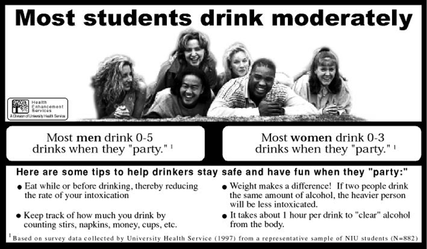
Berkowitz has also applied this approach to addressing sexual violence on university campuses and in the US military. A message that most men seek consent before a sexual encounter helps to reduce the misperception that male peers aren’t seeking active free agreement from a sexual partner.
The emerging case of sexual violence allegedly committed by members of a fraternity house at Cornell University should force us all to ask: how do we address these issues and not simply respond after the fact? The allegations, whilst they are clearly deeply disturbing, also raise questions that extend beyond the individuals accused. What happens when a group normalises language that treats women as objects rather than human beings? What happens when behaviour that should challenge us instead becomes something to joke about, share or ignore? And perhaps most importantly, what happens when decent people are part of that group? We often focus on the individuals who commit harm. We pay less attention to the peers who may witness warning signs, recognise troubling attitudes or have opportunities to intervene.
We shouldn’t assume that everyone in the reported group chat endorsed the message. Nor do we know who challenged it, if anyone did. But these are precisely the questions that active bystandership encourages us to ask.
Culture determines what feels possible
Imagine a workplace where everyone is told: “We expect you to challenge inappropriate behaviour”, but everyone also knows that challenging a colleague is likely to make you unpopular.
Or that challenging someone senior will damage your career.
Or that reporting a colleague automatically means disciplinary action.
Or that people who raise concerns are labelled difficult.
The policy may say one thing. The culture says another. This is why prevention cannot simply be something delivered to people. It has to become something people experience around them. A healthy culture creates psychological permission to act. It makes intervention normal. It allows someone to say: “That’s not okay.” Or: “Are you alright?” Or: “I think we need to stop there.” Early intervention matters because harmful behaviour exists on a continuum. Not every act of inappropriate behaviour becomes sexual violence, but cultures that consistently ignore smaller boundary violations can create environments in which escalation becomes easier.
Sweating the small stuff isn’t about policing every interaction. It is about establishing healthy norms.
The Power Of Peers
One of the most interesting opportunities in prevention is the role of ordinary people. We often look upwards. What will the chief executive do? What will the headteacher do? What will the commanding officer do? What will the police leader do? Leadership matters enormously, but culture doesn’t only flow downwards. Peers create culture too. The friend who challenges the sexist joke. The colleague who checks in when someone’s behaviour changes. The teammate who says, “That’s not how we behave here.” The person who interrupts rather than waits for somebody else to act.
These moments may appear small. Collectively, they are powerful.
Perhaps we are asking the wrong question
So perhaps our prevention conversation needs to move beyond: “What works?” We should also ask: “What gets in the way of doing what works?” That takes us into implementation. It takes us into leadership. It takes us into social norms. It takes us into peer influence. It takes us into fear and hierarchy, and it takes us into active bystandership.
Prevention isn’t simply about giving people information. It is about creating environments where people are motivated, equipped and supported to act. We don’t need every person to become a hero. We need ordinary people to become comfortable doing ordinary things at the right moment.
A conversation.
An interruption.
A challenge.
A check-in.
A refusal to laugh along.
A willingness to say: “Around here, we look out for each other.”
Perhaps the biggest prevention challenge isn’t discovering another thing that works.
Perhaps it is building the cultures, systems and leadership that allow the things we already know work to become normal. We know more than we sometimes think we do, and prevention begins when we close that gap.

